Resume listening
Soundscaper · Kenjin
A soundscape composed for the hour you're actually having.
Sleep, focus, meditation, grief, recovery — you say what the next twenty minutes to eight hours are for, and a session is written for it. Fresh each time. Evidence graded in the open. Nothing pulled from a shelf.
Support areas:8Techniques:17Session length:20 min – 8 hrListening contexts:5
Get early accessOne email, when it opens.Hear what a session sounds like ↓

What it actually is
A composition system, not a playlist.
You arrive with a state and a need. You tell Soundscaper what's going on — type it, speak it, pick from the wizard's options. From there a session is composed for you: the length you have, the listening you're doing, and the support area that fits the thing you're trying to ease. Bedtime, focused rest, meditation, work, caring for someone else — each shapes the session differently.
Underneath every session is a stack of techniques the music-therapy evidence base actually supports — receptive music therapy for low mood and for dementia comfort, breath-paced movement at the body's natural cardiorespiratory rhythm, nature recordings for stress recovery, embedded amplitude modulation for attention. Each one is named on the methods page with what the evidence covers and what it doesn't.
Three things hold across every session. Nothing jolts you — transitions are bridges, not cuts. The session walks an arc rather than a flat line: arrive, settle, deepen, sustain, come back. And the words you type in are read by a language model Kenjin runs on its own servers — never sent to a third-party AI service to compose the session.
The shape of a session
A sequence, not a single block.
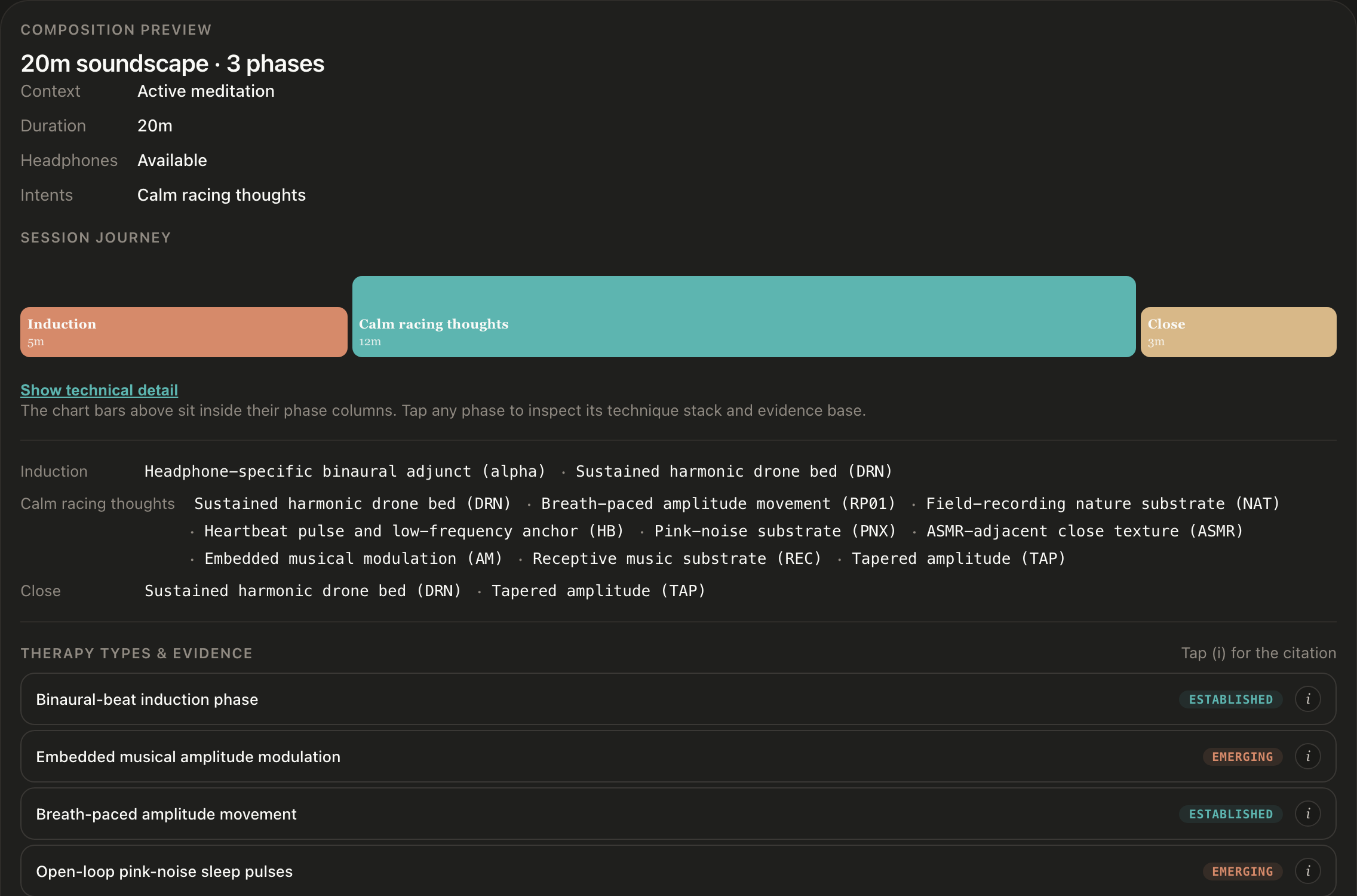
Every session under four hours walks the same arc — settle, deepen, sustain, integrate, close — linked by short bridges instead of cuts. Past four hours it becomes an overnight: a short gateway, a long sustain scheduling pink-noise pulses into your likely sleep windows, then a handoff to sleep. No cues. The audio tapers to silence and stops.
Why you might be reaching for it
Eight support areas. Felt needs, not diagnoses.
A support area is a felt need — the state you brought to the audio — not a diagnosis. Each of the eight has its own page: what the literature actually says, what we're using, what we're deliberately not claiming. The wizard composes for whichever combination you arrive with.
Anxiety and stress
Quiet the racing, decompress after pressure, settle after a spike.
Mood and emotional support
Held space for grief, low mood, loneliness, self-compassion.
Sleep and recovery
Wind-down, sleep onset, the 3am return, the full overnight.
Pain and body comfort
Acoustic distraction; tension release; gentle on a headache day.
Grounding and safety
Trauma-aware audio. Ground after a trigger; come back to the body safely.
Meditation
Sitting practice. The audio is a substrate for what you bring to it.
Focus and clarity
Deep work, study, creative flow, the long stretch when distraction won't leave you alone.
Care companion
Dementia comfort. Sundowning. Procedure prep. And the carer's own reset at the end of the day.
How you'll listen to it
Five listening contexts. Combine them however you like.
The same composition sits very differently in different rooms. The wizard adapts the technique stack to where you are: nature-led for the kitchen, music-led for the desk, the bare composition for advanced practice, the overnight shape for sleep. It suggests a context from your support area; you can override it.
Active work
Music at your desk with the focus-band movement woven through it. Restrained dynamics. Sixty minutes to two hours is the usual range.
Focused listening with headphones
Meditation, contemplation, deep listening. The headphone induction in the gateway phase is available here. Pair with ambient music — or the bare bed, if you've been at it a while.
Sleep, including overnight
From a twenty-minute wind-down to a full eight-hour overnight. Soft pink-noise pulses scheduled into the windows you're most likely asleep in. The audio tapers to silence rather than re-orienting you. Nothing wakes you up.
Open environment, without headphones
Background presence in a room. The headphone-only techniques drop out automatically. Nature-led carriers; conservative high-frequency energy for the long ones.
Care contexts
Sessions for someone you're caring for — dementia, sundowning, convalescence — and for you, the carer, at the end of the day. Minimal variation, nothing surprising, longer phases.
Build your own recipe
Combine the choices however your night actually is.
The wizard puts the choices in your hands — what you hear on the surface, how prominent the technique is, whether anything cues you at the midpoint or the end. Compose for what your night actually is. Headphones in, ninety minutes, settling racing thoughts. Or eight hours overnight in an open room with the audio at a whisper. Or forty-five minutes of focused work with the technique clearly present. The system doesn't guess. It composes for what you tell it.
What you'll actually hear
Five ways the same session can sound.
What sits underneath a session can be packaged five ways. Same composition, same specification — what changes is what you actually hear. Some listeners want the technique invisible under nature recordings; some want the music to be the experience; some want it bare. For the nature carriers you can pick which elements you want — water, rain, wind, forest, birdsong, distant thunder, fire crackle, insects — sourced CC0 only. (Spatial rendering for headphone listeners is on the way; it isn't here yet.)
Nature-first
Water, forest, rain, wind, birdsong on the surface. Music elements absent or faint enough to read as ambience.
Sleep, grounding, dementia comfort, open environments.
Nature-first · 75 seconds from inside a relaxation session.
Nature + composed
Nature underneath, with composed harmony and breath-paced movement clearly present.
The default for anxiety, mood, sleep wind-down, body comfort, meditation.
Nature + composed · 75 seconds from inside a relaxation session.
Soundscaper music
Composed music as the surface — listenable as music in its own right.
Focus, creative flow, deep work, motivation lift, contemplation.
Soundscaper music · 75 seconds from inside a focus session.
Ambient music
Drone-led music, sparse motif, minimal nature, no rhythmic movement.
Meditation, deep contemplation, self-compassion, emotional processing.
Ambient music · 75 seconds from inside a meditation session.
Bare therapy bed
The composition itself with the decoration off: drone, breath pacing, the headphone induction, audible transitions, soft taper.
For experienced meditators, researchers, and listeners who'd rather have the bed than the dressing.
Bare therapy bed · 75 seconds from inside a relaxation session.
The excerpts are from real rendered sessions, unedited apart from a fade at each end.
Where the evidence sits
Three tiers. Every claim, graded.
Most wellness audio either ignores the evidence or oversells it. We grade every claim into one of three tiers, and the tier is visible wherever the claim appears — the methods page, each support-area page, the science page. Citations link to the underlying papers. You can check.
Tier 1
Established
Multiple good RCTs, ideally synthesised in a Cochrane review or peer-reviewed meta-analysis. Independently replicated. Effect sizes that matter. Receptive music therapy in dementia (van der Steen 2024 Cochrane); breath-paced amplitude near 0.1 Hz, the body's resonant cardiorespiratory frequency.
Tier 2
Emerging
Single trials, small-sample work, or evidence with mixed independent replication. The effects look real; the picture isn't settled yet. Binaural-beat induction (perioperative meta-analysis SMD ≈ −1.38, mechanism still contested); open-loop pink-noise sleep pulses (the closed-loop mechanism is strong; open-loop is an approximation of it).
Tier 3
Speculative · design lineage
Cultural or design inspiration only. The architectural shape of the headphone induction phase borrows from the Monroe Institute's Hemi-Sync method as design lineage; we don't inherit its claims. No solfeggio frequencies. No “DNA repair”. None of the wellness habit of inflating thin findings.
What we won't claim
Wellness-adjacent listening. Not clinical treatment.
Soundscaper isn't a medical device, a diagnostic tool, a crisis service, or a treatment. It doesn't treat anxiety. It doesn't cure insomnia. It makes no claim about EEG entrainment, hemispheric synchronisation, or anything from the Gateway consciousness-expansion lineage. The full claim ceiling is at /safety and /science.
Privacy posture
Your words never go to a third-party AI.
The words you write or speak about your state are read by a language model Kenjin runs on its own servers — never sent to OpenAI, Google, or any other third-party AI service. Out of that reading comes a structured profile — your support area, length, context, the choices you've made — and that's what composition runs on. Your intake is handled only by our own systems, under our Data Policy. No analytics cookies. No advertising cookies. No behavioural profiling. There's no consent banner because there's nothing to consent to.
The formal posture is at /privacy-policy. The plain-language version is at /data-policy.
A reflection layer, if you want one
Your journal sits next to each session.
Listening is the work. A reflection on the listening is optional — never a streak, never a prompt, never a guilt loop. The journal sits next to every recording in your library, in three short modes you can use or ignore.
Pre-session — a sentence or two about what you're bringing in, captured before you press play. Post-session — what changed, or didn't, after the audio finished. Standalone— a reflection that isn't tied to a session at all.
The journal is yours alone. Nothing leaves your account unless you opt into the Insights surface later. The full walkthrough lives on the mobile app page.
On every device you use
Pick up the listening on any device.
Compose in the browser or in the native app. Listen in either; download for offline. The mobile player shows the current phase, takes lock-screen controls, runs in the background, and picks up where you left off. The web player runs the same phase-aware timeline. Your account, your library, your journal stay in sync.
 Coming to iOS
 Coming to Android
Mon, 12 May
Recent listeningView all
Focus afternoon40 min · Active work
Forest wind-down60 min · Bedtime · Downloaded
Open meditation20 min · Meditation
Recent reflectionsOpen journal
PostSettled fast. Finished feeling clearer.
PreHeading into focus block. Mostly there.
Disclosure
A note from the founder.
I'm the founder of Soundscaper. This site argues for a category I commercially benefit from, and I've tried to be more sceptical of my own claims than I am of other people's. Where I've slipped, the science page and the boundary section above are where I try to keep myself honest. If you spot a claim here that the evidence doesn't support, email me. That's the credibility loop.
Email: [email protected]